Straßen- und Grünflächenamt Mitte, Fachbereich Grünflächen in Berlin Tiergarten

Straßen- und Grünflächenamt Mitte, Fachbereich Grünflächen in Berliner Stadtteil Tiergarten in Mitte ist eine Behörde (Web: https://www.berlin.de/ba-mitte/politik-und-verwaltung/aemter/strassen-und-gruenflaechenamt/gruenflaechen/), Straße des 17. Juni 31 (10785). Straßen- und Grünflächenamt Mitte, Fachbereich Grünflächen liegt in der Nähe von Eichenallee. Die nächste Bushaltestelle in der Nähe ist Kleiner Stern (ca. 350 m entfernt).
Hausnummer
31
Postleitzahl
10785
Straße
Straße des 17. Juni
Webseite
https://www.berlin.de/ba-mitte/politik-und-verwaltung/aemter/strassen-und-gruenflaechenamt/gruenflaechen/
Landnutzung
Regierungsgebäude

Bild

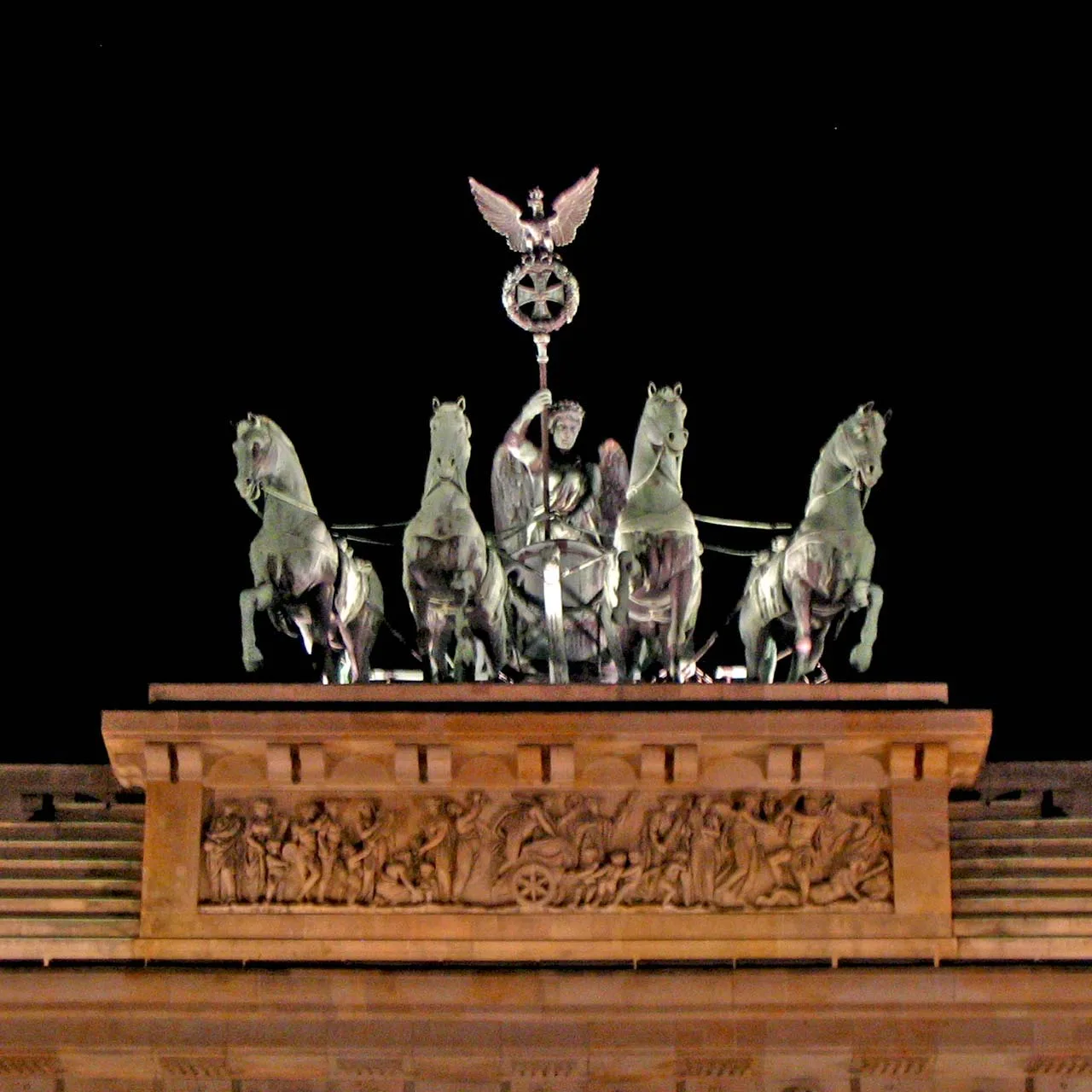
The quadriga atop the Brandenburg Gate —restored since 1991— is shining in pale-verdigris against a black backdrop of a gloomy night. In 1793, — when the so called 'French Revolutionary Wars' all over Europe were to begin —, Schadow installed in an anxious & defiant gesture towards the revolutionary Paris a peace-goddess (PAX) holding up a coronal of olive leaves behind a roman, triumphal carriage. - Under those political circumstances that build-up was obviously meant as an apotropaic allegory against the upcoming, second wave of the Great Revolution which was looming from the other side of the Rhine ... In 1806 that sculpture was of course dislodged and travelled to the Louvre by the victorious Napoléon Bonaparte but already eight years later — in 1814— the booty was tracked down and re-confiscated by the prussian General Blücher. Back in Berlin the restituted trophy was overhauled and revised by Schinkel in 1815: The once pre-reactionary Fräulein PAX (roman peace-goddess) was still turning its back against the Madame France in the West but this time she was classified into a full-blown reactionary NIKE (hellenic victory-goddess). Supporting that lurking tendency he supplemented as some new fittings the erect shaft in between the pairs of horses (“Pferdeherme”), the harness for the four domesticated mammals and the coronet of oak leaves for the goddess, and he set up the “perch”, i.e. the banner-like standard with the iron cross inside a wreath of oak leaves & acorns from which an eagle coronated by a christian cross atop a prussian crown holds lookout. The iron cross on the Brandenburg was posted in 1815 and contains the initials 'FW' and the figure '1813' in remembrance of its endowment as the prussian war decoration by Friedrich Wilhelm III. in the year 1813 which marks the beginning of the first restoration—the second such reanimation was instigated by the Hitlerists in 1933 under the pompous title “Third Reich”—of the 1806 passed away cadaver of the Holy Roma
The quadriga atop the Brandenburg Gate —restored since 1991— is shining in pale-verdigris against a black backdrop of a gloomy night. In 1793, — when the so called 'French Revolutionary Wars' all over Europe were to begin —, Schadow installed in an anxious & defiant gesture towards the revolutionary Paris a peace-goddess (PAX) holding up a coronal of olive leaves behind a roman, triumphal carriage. - Under those political circumstances that build-up was obviously meant as an apotropaic allegory against the upcoming, second wave of the Great Revolution which was looming from the other side of the Rhine ... In 1806 that sculpture was of course dislodged and travelled to the Louvre by the victorious Napoléon Bonaparte but already eight years later — in 1814— the booty was tracked down and re-confiscated by the prussian General Blücher. Back in Berlin the restituted trophy was overhauled and revised by Schinkel in 1815: The once pre-reactionary Fräulein PAX (roman peace-goddess) was still turning its back against the Madame France in the West but this time she was classified into a full-blown reactionary NIKE (hellenic victory-goddess). Supporting that lurking tendency he supplemented as some new fittings the erect shaft in between the pairs of horses (“Pferdeherme”), the harness for the four domesticated mammals and the coronet of oak leaves for the goddess, and he set up the “perch”, i.e. the banner-like standard with the iron cross inside a wreath of oak leaves & acorns from which an eagle coronated by a christian cross atop a prussian crown holds lookout. The iron cross on the Brandenburg was posted in 1815 and contains the initials 'FW' and the figure '1813' in remembrance of its endowment as the prussian war decoration by Friedrich Wilhelm III. in the year 1813 which marks the beginning of the first restoration—the second such reanimation was instigated by the Hitlerists in 1933 under the pompous title “Third Reich”—of the 1806 passed away cadaver of the Holy Roma – Karl-Ludwig Poggemann from Germany, cc by – Wikimedia Commons

Bushaltestellen

  • Kleiner Stern – ca. 350 m.

Kunstwerke

  • Der Sieger – ca. 250 m.
  • Hirsch (Künstler: Rudolf Siemering) – ca. 300 m.
  • Friedrich Wilhelm III. von Preußen (rollstuhlgerecht, Künstler: Friedrich Drake, concrete). Kopie von 1982 des Standbilds von Friedrich Drake. – ca. 300 m.
  • Bär – ca. 300 m.
  • Stier – ca. 300 m.
  • Amazone zu Pferde (Künstler: Louis Tuaillon, bronze) – ca. 350 m.
  • Hirsch (Künstler: Rudolf Siemering) – ca. 350 m.
  • Elch – ca. 350 m.
  • Liegender Bison Ⅱ (rollstuhlgerecht, Künstler: Rudolf Siemering, bronze) – ca. 350 m.
  • Bison (Künstler: Rudolf Siemering, bronze) – ca. 350 m.
  • Bison (Künstler: Rudolf Siemering, bronze) – ca. 350 m.
  • Elch – ca. 350 m.
  • Die glückliche Heimkehr des Kriegers (rollstuhlgerecht, Künstler: Alexander Calandrelli) – ca. 400 m.
  • Wilhelm von Preußen (rollstuhlgerecht, Künstler: Adolf Brütt, marble) – ca. 400 m.
  • Der verwundete Krieger (rollstuhlgerecht, Künstler: Ludwig Brodwolf) – ca. 400 m.

Touristeninformationen

  • Östlicher Tiergarten / Venusbassin – ca. 50 m.
  • Der Tiergarten – ca. 300 m.
  • Zelten-Quartier – ca. 300 m.
  • Floraplatz – ca. 350 m.
  • Großer Tiergarten Berlin – ca. 350 m.
  • Beethoven-Haydn-Mozart-Denkmal (rollstuhlgerecht) – ca. 400 m.

Straßen in der Umgebung

Bellevueallee
Östlicher Tiergarten / Venusbassin
150 m
Platanenallee
Der Sieger
300 m
Ahornallee
350 m
Eichenallee
350 m
Buchenallee
350 m
Rüsternallee
Der Kampf, Der verwundete Krieger, Die glückliche Heimkehr des Kriegers, Abschied des Kriegers von seiner Familie
400 m
Ahornsteig
Friedrich Wilhelm III. von Preußen, Der Tiergarten, Löwengruppe, Global Stone Project
400 m
Straße des 17. Juni
Kleiner Stern, L 601, L 603, L 605, L 607, Infotafel Berliner Mauer, Euronet, L 788, L 786, L 789, L 784, L 780, L 778, L 776, L 774, L 772, L770, L 768, L 766, L 756, L 758, L 760, L 764, L 762, Der Rufer von Gerhard Marcks, Sehenswürdigkeiten/Places of interest (rechts); S-Bhf. Tiergarten, D-Route 3/Europaradweg R1 (links)
400 m
Großer Weg
Das deutsche Volkslied
400 m
Yitzhak-Rabin-Straße
400 m
Haus der Kulturen der Welt
450 m
Tunnel Tiergarten Spreebogen
Grand Hyatt Berlin, Legoland Discovery Centre, Grand Hyatt, Bistro Mitte, Trek, Fräulein Kimchi, 1838 Deli, Amazone zu Pferde, L 600, Hirsch, Elch, Stier, Großer Tiergarten Berlin, Floraplatz, L 790, Beethoven-Haydn-Mozart-Denkmal, Theater am Potsdamer Platz, Galileo, Prince Frederick Arthur of Homburg, General of Cav, Boxers, Spielbank Berlin, Viet Bowl, Sternberg - Theater in der Spielbank, Cafeteria, Stabi Kantine, Punch Line
450 m
Herbert-von-Karajan-Straße
Philharmonie, Johanna und Eduard Arnhold Platz
450 m
Kastanienallee
450 m
Große Querallee
Skulpturenpark - Skulpturen gegen Krieg und Gewalt, Große Knospe III/63, Todes Mauer Bruch, Zelten-Quartier
450 m
Tiergartenstraße
Tiergarten, Tiergartenstraße, Wegzeichen 3a, Wilhelm von Preußen, Nordische Botschaften/Adenauer-Stiftung, Orpheus, Gästehaus, Richard Wagner, Anatolische Zugvögel
500 m
Bremer Weg
Liegender Bison Ⅱ, Bison, Elch, Florastatue
500 m
John-Foster-Dulles-Allee
Wildschwein, Haus der Kulturen der Welt, Karte Tiergarten, Der Rhein, Die Elbe, Die Oder, Die Weichsel, Großfürstenplatz, Large Divided Oval: Butterfly, Platz der Republik
500 m
Platz der Republik
Platz der Republik
600 m
Paulette Nardal Terrasse
Haus der Kulturen der Welt / John-Foster-Dulles-Allee, Weltwirtschaft, HKW
600 m
Heinrich-von-Gagern-Straße
Kroll-Oper Berlin
650 m
Magnus-Hirschfeld-Ufer
650 m
Bettina-von-Arnim-Ufer
650 m
Reichstag/Bundestag
Reichstag/Bundestag
750 m
Paul-Löbe-Allee
Bundestag, U Bundestag, Fotofix
750 m
Joachim-Karnatz-Allee
HonigStein Cafe, Trattoria Fidelia
750 m
Kanzleramtssteg
800 m
Ingeborg-Drewitz-Allee
850 m
Alice-Berend-Straße
850 m
Elisabeth-Abegg-Straße
Zollpackhof
900 m
Willy-Brandt-Straße
Berlin
900 m

Bauflächen in der Umgebung

Erweiterungsbau für das Kanzleramt
850 m

Einzelhandelsgebäude in der Umgebung

Berlin-Pavillon
750 m

Flüsse in der Umgebung

Spree
800 m

Gestrüppe in der Umgebung

Dornröschenwäldchen
700 m

Gewerbegebiete in der Umgebung

Bundesministerium des Innern
850 m

Gewässer in der Umgebung

Venusbassin
450 m

Grasflächen in der Umgebung

Kanzlergarten
800 m

Gärten in der Umgebung

Steppengarten
450 m
Paradiesgarten
650 m
Urgarten
700 m

Kunstwerke in der Umgebung

Zusammenhalt
850 m

Parks in der Umgebung

Luiseninsel
300 m

Sehenswürdigkeiten in der Umgebung

Sowjetisches Ehrenmal Tiergarten
600 m
Bundeskanzleramt
800 m

Sonstiges in der Umgebung

Floraplatz
350 m
Zeltenplatz
400 m
Kleiner Stern
Kleiner Stern
400 m
Großfürstenplatz
550 m